CRISPR sgRNA Library Design Guide
Use this guide to structure sgRNA design decisions and review the evidence behind guide ranking. It does not generate target-specific guides or prescribe universal activity, control, coverage, or acceptance thresholds. For application planning, continue to the CRISPR library workflow; use the CRISPR experiment planner for input-based MOI/cell-scale estimates, the Coverage Calculator for geometric spacing, and Batch Sequence QC for sequence flags.
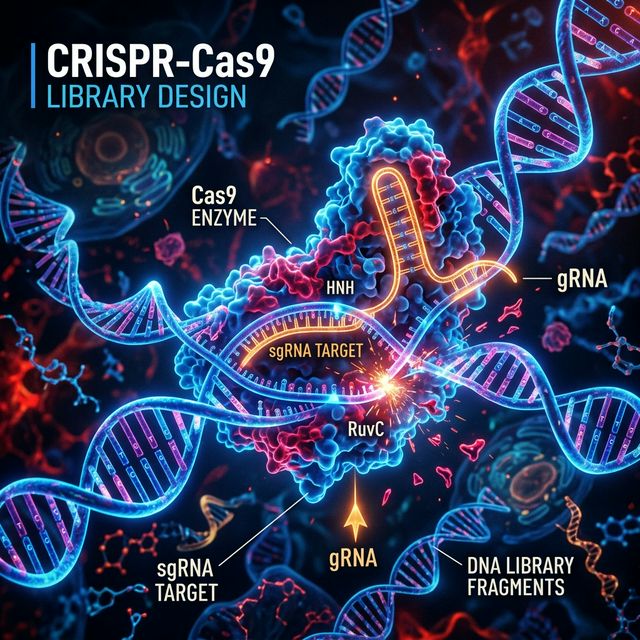
Separate guide selection, geometric sizing, and study-specific QC decisions.
Key Takeaways
- Choose the perturbation mode and nuclease from the study question, target, delivery system, and current construct documentation.
- Use a scoring model only within its documented organism, nuclease, assay, and training-data scope; a score is not a measured activity result.
- Set guide redundancy, controls, representation, and sequencing criteria in the study plan rather than applying universal counts or thresholds.
- Assemble the complete oligo from the selected vector map and supplier specification; spacer-only checks do not validate the final construct.
- Use sequence tools to flag candidates for review, then use measured library data and protocol-defined acceptance rules for experimental decisions.
What are you trying to decide?
Related planning pages
Open the CRISPR library guideEstimate MOI-adjusted cell scale from plan inputsEstimate target spacing and geometric gapsReview sgRNA sequences for selected flagsReview pool synthesis method trade-offsReview observed per-guide read counts after sequencingTroubleshoot dropout, skew, and cloning failures
Page contents
Which CRISPR Library Format Fits Your Screen?
Start by matching the library format to the study question. Knockout, CRISPRa, CRISPRi, base editing, and tiling require different constructs and validated design methods; set redundancy and QC rules from the selected study plan.
| Library type | Design question | Confirm before ranking |
|---|---|---|
| CRISPRko | Disrupt a target gene or element | Effector, transcript definition, target region, and study-specific redundancy |
| CRISPRa | Increase expression from selected targets | Activation construct, target annotation, and model-specific window |
| CRISPRi | Reduce expression from selected targets | Repressor construct, target annotation, and model-specific window |
| Base editing | Create a specified base change | Editor, editable sequence context, bystander review, and desired outcome |
| Tiling | Map functional regions across an interval | Interval boundaries, nuclease constraints, spacing rule, and analysis plan |
What nuclease details should you verify?
| Design field | What to record | Why it matters |
|---|---|---|
| Nuclease and variant | Exact construct or variant identifier and source | Design constraints can differ by nuclease and construct |
| PAM | Sequence, orientation, and source convention | Candidate selection depends on the documented target context |
| Spacer boundaries | Selected spacer definition and any construct-specific sequence additions | The submitted sequence must match the chosen design workflow |
| Cut-site convention | How the design tool reports the cut position | Coordinates need a consistent reference when reviewing target placement |
| Model scope | Organism, perturbation mode, assay, model version, and intended output | A score should only be interpreted within its documented scope |
How Should You Filter and Rank sgRNAs?
Treat guide scores as model outputs, not universal pass/fail values. Record the reference genome, transcript choice, nuclease, scoring model and version, and the rule used to retain or reject each candidate.
| Review area | What to verify | Decision record |
|---|---|---|
| Target definition | Reference genome, transcript/isoform, and target-region annotation | Keep the annotation and version used for design |
| Nuclease and construct | PAM orientation, spacer boundaries, promoter, scaffold, and cloning map | Check against the selected nuclease and vector documentation |
| On-target ranking | Model, version, organism, perturbation mode, and score meaning | Record the study-specific ranking rule; do not equate score with measured activity |
| Off-target review | Reference genome, search method, mismatch model, and reported outputs | Record the rule and any unresolved candidate for review |
| Sequence composition | GC, low-complexity, homopolymer, and promoter-dependent motif flags | Treat tool flags as review prompts under the selected protocol |
| Library redundancy | Independent guide design and statistical plan | Record why the selected redundancy fits this experiment |
How should you compare scoring models?
Record each model's publication, version, organism, nuclease, assay, training data, and intended output. Compare candidates only when the models address the same task; a score scale or ranking from one model cannot be transferred to another without its documentation.
Off-target scores: Record the model name and the direction/meaning of its output from the source documentation. Check the reference genome and mismatch assumptions before comparing candidates.
If a model does not document support for the chosen organism, nuclease, or perturbation mode, treat its score as out of scope rather than as a validated ranking for that design.
Review sequence composition with the GC Content Analyzerand selected sequence flags with Batch Sequence QC. Interpret any flag using the selected design method and construct documentation.
How Large Will the Library and Screen Be?
Keep geometric target spacing separate from experiment-scale calculations. Guide selection, controls, cell scale, sequencing depth, and acceptance rules depend on the study and are not outputs of a spacing estimate.
| Decision | Inputs to define | Use this page/tool for |
|---|---|---|
| Guide selection | Target annotation, nuclease, model scope, and study redundancy | Use the design method and its source documentation |
| Target geometry | Target length, oligo/guide length, spacing or overlap, and redundancy | Use the Coverage Calculator for geometric count and gap estimates |
| Cell/MOI scale | Guide/control count, desired cells per guide, MOI, replicates, and assumptions | Use the CRISPR Library Experiment Planner as a scenario estimate |
| Sequencing/QC plan | Measured output, read-count denominator, decision rule, and protocol | Use post-sequencing read-count analysis; do not infer a universal threshold |
Use the Coverage Calculator for target-spacing geometry. For MOI-adjusted cell estimates, use the CRISPR Library Experiment Planner; its outputs depend on the entered assumptions and are not an assay protocol or statistical-power analysis.
What Should Each CRISPR Library Oligo Contain?
The submitted sequence is defined by the expression construct and supplier format. Use the current vector map and protocol to assemble every variable and constant region, then calculate the complete sequence length.
Construct map to check
5'-[primer region]-[cloning junction]-[guide sequence]-[scaffold/constant region]-[primer region]-3'
| Element | Source of truth | Check |
|---|---|---|
| Guide sequence | Nuclease and design method | PAM orientation and submitted boundaries |
| Scaffold and expression context | Vector map and expression protocol | Sequence, orientation, and junction |
| Cloning junctions | Current construct and enzyme protocol | Recognition sites, overhangs, and reading/orientation constraints |
| Primer-binding regions | Amplification protocol | Compatibility with the selected amplification workflow |
| Barcode or other variable regions | Study manifest and supplier template | Uniqueness, position, and permitted alphabet |
| Full submitted sequence | Complete map plus supplier tier | Validate final length and format against the current quote/specification |
Verify your full oligo sequences (guide plus all construct-defined regions) through our Batch Sequence QC tool before ordering synthesis. This checks for unintended restriction sites that would interfere with cloning, as well as secondary structures that could impair PCR amplification of the pool.
Which Sequence Checks Should You Run Before Ordering?
Screen the complete submitted construct, not only the spacer. These tools flag selected sequence features for review; they do not predict guide activity, synthesis success, or assay performance. Set follow-up rules from the selected nuclease, expression cassette, amplification protocol, and current supplier requirements.
TTTT Motif Check
Review poly-T motifs against the promoter and expression cassette. A flag is a prompt to check the selected construct, not a universal activity verdict.
Use Batch QCGC Content Analysis
Use GC percentage as a composition screen. Choose any review band from the selected design method and assay evidence; the analyzer does not establish guide activity or synthesis acceptance.
Use GC AnalyzerSecondary Structures
Predicted structures are model outputs. Review the sequence region, scaffold, conditions, and assay-specific interpretation; the predictor does not measure Cas9 loading or PCR yield.
Use Structure PredictorTm Uniformity
Calculate primer Tm from the documented amplification conditions when needed. The Tm tool does not validate a universal handle range or predict pool amplification performance.
Use Tm CalculatorHow Do You QC the Library After Synthesis and Cloning?
After synthesis and cloning, use observed data and a predeclared study rule to decide what the results support. Keep vendor-reported measurements, plasmid-library sequencing, viral titer, transduction, and screen outcomes distinct; no single metric here defines release for every assay.
| QC Stage | Metric | Define before review | Possible next question |
|---|---|---|---|
| Received pool | Per-guide read counts and detection rule | Define denominator, sampling, and detection rule from the assay plan | Which guides are missing or below the predeclared rule? |
| Received pool | Uniformity metric | Name the metric, calculation, and comparison set | Does the reported metric match the study decision? |
| Received pool | Dropout definition | Define how dropout is calculated and at which workflow stage | Could sampling or analysis choices explain the observation? |
| Viral preparation | Titer measurement | Record method, units, cell context, and date | Does the measured preparation meet the assay plan? |
| Transduction | MOI estimate | Record the titration method and target-cell conditions | Are the conditions comparable to the planned screen? |
| Screen setup | Cells per guide / representation | Calculate from the study inputs and document assumptions | Use the CRISPR Experiment Planner for arithmetic, then apply the study protocol |
| Screen analysis | Replicate agreement | Choose the statistic and decision rule before examining outcomes | Do normalization and replicate assumptions fit the analysis plan? |
Use the NGS Pool QC Analyzer to inspect observed per-guide read counts. The Coverage Calculator estimates target-spacing geometry, not sequencing depth or screen coverage; use the CRISPR Library Experiment Planner for input-based cell-scale arithmetic and confirm experimental rules in the study protocol.
Building a study-specific design record
No customer design, measured screen result, or current supplier quote is available here to support a worked CRISPR example. Record the inputs below for your own study before calculating a pool or requesting quotes.
Define Your Gene List
Record the organism, reference genome, target regions or transcripts, inclusion rules, and annotation version. Define the target set from the study question and documented source set.
Select and document a guide-design method
Record the selected design tool, model/version, nuclease, perturbation mode, organism, ranking interpretation, and off-target method. Set redundancy and control counts from the study plan and cited design precedent.
Add Constant Regions
Assemble the full sequence from the selected vector map and protocol, then record constant regions, barcodes, cloning junctions, and submitted length. Run the final manifest through Batch QC; review its selected flags against study criteria rather than treating a pass rate as an experimental outcome.
Order and Screen
Record the current supplier quote, product tier, delivery format, QC scope, and portal template. Use the CRISPR Library Experiment Planner for input-based cell-scale arithmetic, then confirm cloning, culture, sequencing, budget, and schedule requirements against current study and supplier sources.
This is a planning template, not a customer case or validated protocol. No guide count, QC pass rate, price, experimental result, or schedule is implied.
Which sgRNA Design Tool Fits Your Project?
Compare tools using their current documentation for organism, nuclease, perturbation mode, model version, score interpretation, off-target assumptions, supported inputs, and outputs. The legacy capability matrix below lacks dated source records, so it has been replaced with a comparison checklist.
| Compare | Record | Why it matters |
|---|---|---|
| Design scope | Organism, genome build, nuclease, and perturbation mode | Model support is specific to the documented use case |
| Ranking output | Model name/version, score meaning, and published evaluation scope | Scores from different methods are not directly interchangeable |
| Off-target review | Reference genome, search method, and mismatch assumptions | A reported score depends on its search and interpretation rules |
| Workflow fit | Input limits, export format, and current availability | Confirm the selected tool supports the actual manifest and study |
After choosing a design workflow, use Batch Sequence QC to screen the assembled sequences for selected flags. This does not rank guide efficacy or establish supplier acceptance.
How Should You Plan Project Cost and Timing?
No current quotes, facility estimates, or project schedule were supplied. Compare the stages using your own dated quotes, protocol, facility capacity, and analysis plan.
| Phase | Inputs to collect | Cost basis | Schedule dependency | Decision record |
|---|---|---|---|---|
| Guide design | Current tool access and required review | Staff time and any current service quote | Target set, model scope, and review depth | Model/version and design decisions |
| Oligo synthesis | Final manifest, length, modifications, and delivery format | Comparable dated supplier quotes | Product tier, queue, and quoted turnaround definition | Selected tier and QC scope |
| Cloning + QC | Vector, cloning method, controls, and measurement plan | Reagents, facility, and sequencing quote | Protocol and facility availability | Acceptance criteria and data source |
| Virus production | Construct, target cells, and titration plan | Facility or service quote | Availability and measured titer workflow | Titer method and study threshold |
| Screen execution | Guide count, controls, cells, replicates, and MOI assumptions | Cell culture and facility estimate | Assay duration and capacity | Protocol-specific scale |
| Sequencing + analysis | Library complexity, sampling, and analysis method | Sequencing and analysis quote | Run availability and analysis workflow | Predeclared read-count rule |
| Project total | Sum project-specific estimates | Use current quotes | Use confirmed dependencies | Update before committing resources |
Cloning efficiency and protocol parameters depend on the selected vector, enzyme, transformation workflow, and local facility. Use the current construct protocol and measured transformation data; the prior fixed recipe and efficiency values had no reproducible source record.
Which Controls Should You Include in the Library?
Choose negative, positive, and mode-specific controls from the study question and analysis plan. Record the source and intended interpretation for each set; this guide does not prescribe universal control counts.
| Control Type | Define from | Purpose | Source | Record |
|---|---|---|---|---|
| Non-targeting | Analysis plan and relevant control-design source | Null distribution or comparison specified by the analysis | Selected control source | Sequence set and interpretation |
| Safe-harbor targeting | Study question, organism, and reference genome | Target definition and rationale | Target annotation source | Sequence set and interpretation |
| Essential gene | Perturbation mode and selected published library/protocol | Control-set behavior specified by the analysis | Library or protocol version | Sequence set and interpretation |
| Known drug target | Study hypothesis and cited target set | Target-specific comparison in the study plan | Target-set source | Inclusion rule and interpretation |
| Reporter targeting | Available reporter construct and assay plan | What the control measures in this workflow | Construct and assay source | Sequence set and expected readout |
Representation check: Select the control set, read-count denominator, normalization, metric, and review rule before analyzing results. Control distributions can reflect biological and technical effects; interpret them within the study design rather than using a universal fold-variation cutoff.
How Should You Package Virus and Set MOI?
Use the selected vector protocol and cell system to set packaging, titration, infection, and selection conditions. The values below previously mixed different assays without a documented source and are replaced with the inputs needed for a study-specific plan.
| Parameter | Input / evidence to record | Use | Source of decision |
|---|---|---|---|
| MOI estimate | Titration method, target cells, replicate conditions | Scenario input | Selected construct and assay protocol |
| Transduction | Measured fraction and measurement conditions | Observed result | Cell-specific titration protocol |
| Viral titer | Method, units, cell context, and date | Observed result | Facility method and vector protocol |
| Cells per guide | Guide/control count, MOI, replicates, desired representation | Input-based arithmetic in the CRISPR planner | Study design and protocol |
| Selection | Agent, dose, duration, and control conditions | Study condition | Vector and target-cell protocol |
| Bottleneck | Sampling stage and retained population | Study-specific review | Analysis plan and measured data |
Scenario calculation: Enter guide count, cells per guide, MOI, replicates, controls, and bottleneck assumptions in the CRISPR Library Experiment Planner. Its arithmetic uses those inputs; choose them from the study protocol and do not treat the output as a universal recommended cell count.
MOI check: Use the titration design and selection readout specified for the vector and target cell. Record viral lot, handling, dilution series, controls, and calculation method; this guide does not supply a universal dilution recipe or survival-to-MOI conversion.
Frequently Asked Questions
How many guides should I include per target?▾
There is no guide count that applies to every screen. Set redundancy from the perturbation mode, study question, statistical plan, available cells and sequencing capacity, and the design precedent you choose. Record the source and assumptions so the library size can be recalculated when the plan changes.
What is the difference between CRISPRko, CRISPRa, and CRISPRi libraries?▾
CRISPRko aims to disrupt a target, while CRISPRa and CRISPRi aim to change expression using nuclease-dead effectors and mode-specific constructs. Their target windows and ranking rules depend on the effector, transcript annotation, organism, and validated design method; use the protocol and model documentation selected for your study.
Why should I avoid TTTT sequences in sgRNAs?▾
A poly-T flag can matter when the chosen construct uses a Pol III promoter, but the effect depends on the expression cassette and sequence context. Check the vector and study protocol, and treat a screening flag as a review prompt rather than a universal activity verdict.
What Cas systems can I use for CRISPR screens?▾
Choose a nuclease whose documented PAM and spacer requirements fit the target and whose construct fits the delivery plan. Confirm the exact sequence boundaries, expression cassette, and design-model support in the current nuclease and vector documentation; this guide does not rank variants or claim delivery compatibility.
How do I analyze CRISPR screen results?▾
Use the analysis method and normalization specified by the study, then review its required inputs, controls, replicate design, and assumptions. For library representation, compare observed per-guide counts with the predeclared QC rule; this guide does not prescribe a universal read depth or replicate-correlation cutoff.
What controls should I include in my CRISPR library?▾
Select negative, positive, and mode-specific controls to answer the study question and support the chosen analysis. Define their sequences, number, and interpretation from the assay protocol or a relevant published library; there is no universal control fraction for every screen.
Related Tools
Coverage Calculator
Estimate target tiling and guide-spacing geometry; this is not cell coverage or sequencing depth.
CRISPR Library Experiment Planner
Calculate cell-scale scenarios from guide count, MOI, replicate, and representation inputs.
GC Content Analyzer
Calculate GC composition and review selected-profile flags without a universal sgRNA pass band.
Batch Sequence QC
Screen selected sequence features; flags do not predict guide activity or vendor acceptance.
Secondary Structure Predictor
Calculate predicted structure outputs for submitted sequences and review them in assay context.
NGS Pool QC Analyzer
Inspect observed per-guide read-count data after sequencing.
Related CRISPR Library Pages
Continue with the pool-ordering, QC, or CRISPR guide that matches the next job after library design.
Plan Oligo Pool Synthesis from Design to QC
Open synthesis planning when platform choice, quote strategy, and delivery planning come next.
What QC Should I Request for Oligos?
Use this when the next decision is vendor QC expectations, purification, or acceptance criteria.
Open the CRISPR Library Guide
Switch to the execution guide when you already know the core library architecture.
Open the Pool QC Walkthrough
Move here if the guide set is stable and the next job is a hands-on pre-order QC pass.
Design and Validate PCR Primers
Useful when your CRISPR project also includes primer or amplicon checks around library validation.