NGS Panel Oligo Pool Design for Capture and Amplicon Probes
Use this page when you need to turn a target list into a pre-order hybrid capture or amplicon panel review. Start with the main oligo pool guide first if you need the broader design, synthesis, QC, or vendor-decision sequence. It walks through panel sizing, probe tiling, Tm normalization, QC flags, and validation planningbefore you order a custom NGS panel oligo pool.
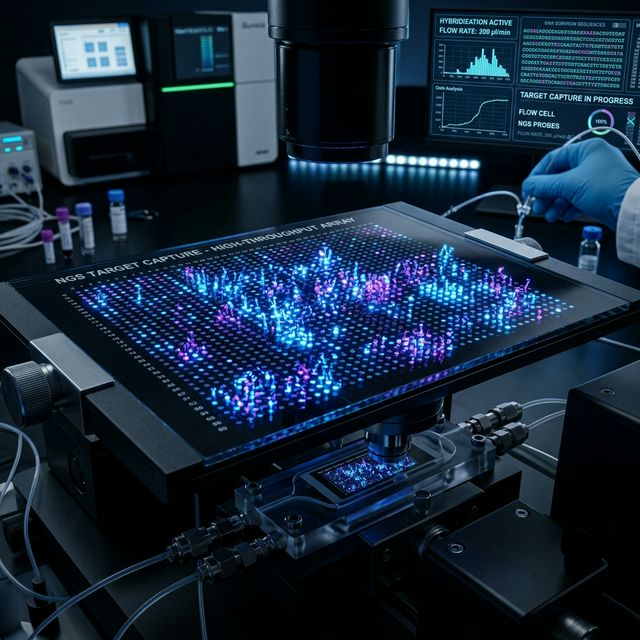
Illustration of probes in a targeted sequencing workflow.
Key Facts
- •Choose hybridization capture or amplicon design from target scope, assay workflow, and available input
- •Set probe or amplicon design parameters using the selected platform and protocol
- •Derive oligo count from the actual target intervals and design output, including controls
- •Define panel QC metrics and acceptance criteria before ordering and validation planning
Capture vs. Amplicon: Which Panel Are You Building?
| Feature | Hybridization Capture | Amplicon-Based |
|---|---|---|
| Mechanism | Biotinylated probes hybridize to targets | PCR primers amplify targets |
| Oligos per target | Derive from probe tiling design | Design primer pairs for each amplicon |
| Target scope | Set from platform and capture workflow limits | Set from assay design and multiplex constraints |
| Uniformity | Measure with the chosen panel QC workflow | Evaluate with assay-specific validation |
| On-target performance | Measure with representative samples | Measure with representative samples |
| Input material | Follow the selected library-preparation protocol | Follow the selected library-preparation protocol |
| Workflow fit | Consider broader or discontinuous target intervals | Consider targets suited to multiplex PCR |
| Oligo Pool Cost | Varies (contact vendor) | Varies (contact vendor) |
Panel Sizing Inputs and Probe-Count Calculation
These categories organize the inputs for a design calculation; they do not provide typical panel sizes, probe counts, or pricing. Derive the final count from the target intervals, tiling design, controls, and selected assay workflow.
| Design input | Target definition | Coverage calculation | Oligo count | Cost |
|---|---|---|---|---|
| Hotspot panel | Selected loci and required flanks | Sum the designed target intervals | Use design output plus controls | Obtain a quote for the specified design |
| Gene panel | Selected transcripts, exons, or loci | Sum included intervals and exclusions | Use design output plus controls | Obtain a quote for the specified design |
| Panel with fusions | Define breakpoints or intronic regions required by assay | Calculate from included intervals | Use design output plus controls | Obtain a quote for the specified design |
| Exome-scale design | Use the selected reference and target definition | Calculate from final interval set | Use design output plus controls | Confirm the vendor product tier |
| Custom research panel | Define regions from the experimental question | Calculate from final interval set | Use design output plus controls | Obtain a quote for the specified design |
Pre-Order Checklist for Custom NGS Panels
1
Define Target Regions
Create the interval list from the assay question, reference version, required flanks, and exclusions. Use coverage tools only for sizing tasks they support.
Use Coverage Calculator →2
Choose Capture or Amplicon Design
Apply the selected platform's rules for probe or primer design, tiling, specificity, and target accessibility.
3
QC the Designed Oligos
Review sequence-level GC, homopolymers, and secondary-structure flags as screening signals; confirm assay acceptance criteria separately.
Use Batch QC →4
Check Design Compatibility
Compare sequence length, modifications, and required handles against the chosen product and assay documentation.
Use Tm Calculator →5
Order & Validate
Confirm design files, product tier, and QC scope with the vendor. Validate the panel using controls and criteria defined for the assay.
Frequently Asked Questions
How many oligos do I need for a targeted NGS panel?▾
The count depends on the target intervals, assay type, probe or primer design, tiling density, exclusions, and controls. Calculate from the actual design output; a gene count alone is not enough to determine an order quantity.
What probe length works best for capture panels?▾
Probe length is assay- and platform-dependent. Use the selected capture workflow's design guidance, then confirm the chosen length and modification are supported by the current synthesis product tier.
How do custom oligo pool panels compare to pre-made panels?▾
Compare target coverage, validation evidence, per-sample workflow, upfront design and synthesis costs, and expected sample volume. A break-even point requires current quotes and workflow costs; this page does not assume one.
Can I use oligo pool probes for both DNA and RNA capture?▾
Do not assume a DNA capture design transfers directly to RNA. Confirm probe chemistry, target preparation, capture protocol, and supported modifications with the assay and synthesis provider.
Related NGS Panel Pages
Design a CRISPR sgRNA Oligo Pool
Size knockout and CRISPRa/i guide pools, then run QC before ordering.
Design a Mutagenesis Oligo Pool
Plan DMS and saturation libraries with explicit variants and assay-defined coverage review.
Assemble Synthetic Genes from an Oligo Pool
Plan fragment overlaps, amplification, and assembly before synthesis.
Review Oligo Pool Design Rules
Check sequence constraints that commonly break probe synthesis or panel uniformity.
Compare Oligo Pool Vendors
Match panel scale, length tier, QC scope, turnaround, and quote terms.
Plan Oligo Pool Synthesis from Design to QC
Use synthesis planning when method trade-offs, quote planning, and QC definitions shape the next decision.
Interpret Oligo Pool QC Metrics
Define representation, dropout, and uniformity metrics after sequencing.