CRISPR sgRNA Oligo Pool Design for Coverage and QC
Use this page when you need to turn a knockout, CRISPRa/i, or base-editing guide list into an order-ready pool. Start with the main oligo pool guide first if you still need the generic design, synthesis, QC, or vendor-decision sequence. It covers pool sizing, pre-synthesis QC, cloning adapters, vendor fit, and sequencing thresholdsso you can catch avoidable failures before placing a CRISPR screen order.
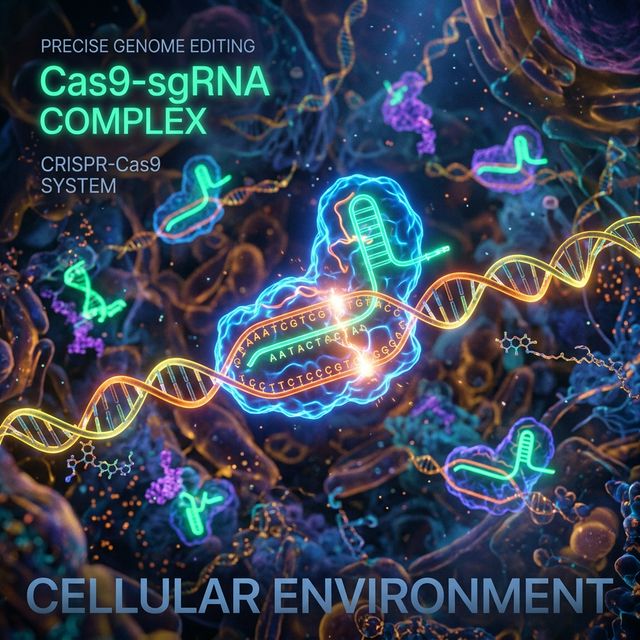
Hundreds of thousands of synthesized sgRNAs directing Cas9 nucleases in a pooled genetic screen.
Key Facts
- •Oligo pools are 60-150x cheaper per guide than individual synthesis for library-scale CRISPR
- •Typical full oligo length depends on spacer, scaffold, adapters, and cloning context; confirm final length before quoting
- •QC targets: ≥90% representation, <10% dropout, Gini <0.25, ≥500x NGS depth
- •Pre-synthesis batch QC catches 5-15% problematic guides (poly-T, extreme GC, hairpins)
Typical CRISPR Screen Pool Sizes
| Screen Type | Genes | Guides/Gene | Pool Size | Quote Input |
|---|---|---|---|---|
| Genome-Wide KO (Brunello) | 19,114 | 4 | ~77K | Confirm full-length tier and QC scope |
| Genome-Wide KO (GeCKO v2) | ~19,000 | 6 | ~123K | Confirm sub-pool and delivery format |
| Genome-Wide CRISPRa/i | ~19,000 | 10 | ~200K | Confirm library tier and raw QC data |
| Kinome/Druggable Genome | 500-2,000 | 8-10 | 4K-20K | Confirm minimum order and controls |
| Pathway-Focused | 50-500 | 6-10 | 300-5K | Confirm whether pool ordering still beats individual oligos |
| Tiling (Regulatory) | Loci-based | 1/5-10 bp | 1K-100K | Confirm full insert length and barcode handling |
Add 1,000 non-targeting controls per library. Pricing varies by vendor — contact directly for quotes. Use Coverage Calculator for exact sizing.
Pre-Order Checklist for CRISPR sgRNA Pools
Select sgRNA Sequences
Use CRISPick (Broad), Benchling, or GPP to generate 4-10 guides/gene. Filter: Doench >0.5, MIT off-target >50.
Use Check GC Content →Screen for Synthesis Problems
Flag poly-T (>3 nt = Pol III termination), extreme GC (<25% or >75%), homopolymers (>4 nt), and hairpins (ΔG < -3 kcal/mol).
Use Batch QC →Add Scaffold & Adapters
Append tracrRNA scaffold (76 bp for SpCas9) + cloning adapters (CACCG for BsmBI). Final: ~105 bp.
Use Format for Vendor →Verify Full-Length Oligos
Re-check assembled oligos for new secondary structures at scaffold-spacer junctions. Verify length uniformity (±5 bp).
Use Check Structures →Submit Synthesis Order
Export as FASTA with unique IDs (gene_guideN). Select a vendor based on pool size, length tier, QC wording, turnaround, and quote scope.
Use Compare Oligo Pool Vendors →QC Thresholds Before You Clone or Sequence
| Metric | Minimum | Ideal | Why It Matters |
|---|---|---|---|
| Representation | ≥90% | ≥95% | Missing guides = missed phenotypes |
| Dropout Rate | <10% | <5% | High dropout reduces screen power |
| Uniformity (CV) | <5-fold | <3-fold | Skew requires deeper sequencing |
| Gini Coefficient | <0.35 | <0.20 | Lower = more equal distribution |
| NGS Depth | ≥500x/guide | ≥1000x | Needed to detect rare guides |
Use Uniformity Estimator and Error Rate Calculator for pre- and post-synthesis analysis.
Which Vendor Details Matter for a CRISPR sgRNA Pool?
| Decision Field | Confirm Before Quote | CRISPR-Specific Risk |
|---|---|---|
| Library scale | Final guide count, control count, and sub-pool structure | Wrong tier selection can create dropout or force late file splitting. |
| Full insert length | Spacer plus scaffold, cloning handles, barcodes, and adapters | A guide-length design can become a longer synthesis problem after constants are added. |
| QC deliverable | Representation report, dropout metrics, raw per-guide reads, and depth | Screen quality depends on guide-level representation, not only aggregate QC. |
| Delivery amount | Material amount, normalization status, and whether amplification is expected | Too little starting material can bottleneck cloning and replicate setup. |
| Submission file | FASTA/CSV/Excel template, sequence ID rules, and forbidden characters | Submission stalls can happen after biological design is already complete. |
See the current oligo pool vendor comparison and the public vendor specifications before requesting quotes.
Frequently Asked Questions
How many oligos do I need in a CRISPR screening pool?▾
Which vendors are best for CRISPR oligo pools?▾
What is the typical oligo length for a CRISPR pool?▾
How do I QC a CRISPR oligo pool?▾
Can I reuse one oligo pool for multiple screens?▾
Related CRISPR Pool Pages
Design a Custom NGS Panel Oligo Pool
Turn target regions into a hybrid capture or amplicon panel before ordering.
Design a Mutagenesis Oligo Pool
Plan DMS and saturation libraries with explicit variants and balanced coverage.
Assemble Synthetic Genes from an Oligo Pool
Plan fragment overlaps, amplification, and assembly before synthesis.
Design an Oligo Pool Before Ordering
Review pool design constraints before locking guide count, controls, and order format.
Read Oligo Pool QC Metrics
Uniformity, error rate, and QC metric deep dive.
Compare Oligo Pool Vendors
Match CRISPR pool scale, QC scope, delivery assumptions, and quote terms.